
The million-dollar question, “Who are you, Banksy?”, continues to fascinate the countless admirers of the man often regarded as the most sought-after “rock star” of street art. Dozens of theories have emerged regarding his true identity, yet he remains determined to stay anonymous, continually outsmarting the public with subversive artworks and provocative stunts around the globe.
One popular theory suggests that Banksy is actually Robert Del Naja, a member of the electronic music group Massive Attack, based on the apparent correlation between Banksy’s works and the band’s tour schedule. Another theory points to an otherwise unknown man named Robin Gunningham. Others have speculated that Banksy is not a single individual at all, but rather a collective of artists, possibly even directed by a woman. This air of mystery has become an integral part of Banksy’s story and appeal, significantly enhancing his public profile.

Photo: Wikimedia Commons
The only verified fact is that Banksy was born and raised in Bristol, England, during the 1970s. His work emerged from the city’s underground street art scene, which fostered collaboration between artists and musicians. He rose to prominence in the early 1990s, and before long his artworks began appearing on walls, bus stops, and buildings throughout Bristol, London, and other British cities.
Banksy is widely regarded as one of the world’s most provocative artists, gaining recognition through politically charged street art and graffiti that combine social criticism with anti-capitalist messages and opposition to consumerism, violence, and militarism. His works protest abuses of power, occupation, social injustice, and the exploitation of low-wage workers. From the beginning of his career, he relied on a distinctive combination of dark humor and stencil techniques, allowing him to work quickly and anonymously while creating a recognizable artistic signature.
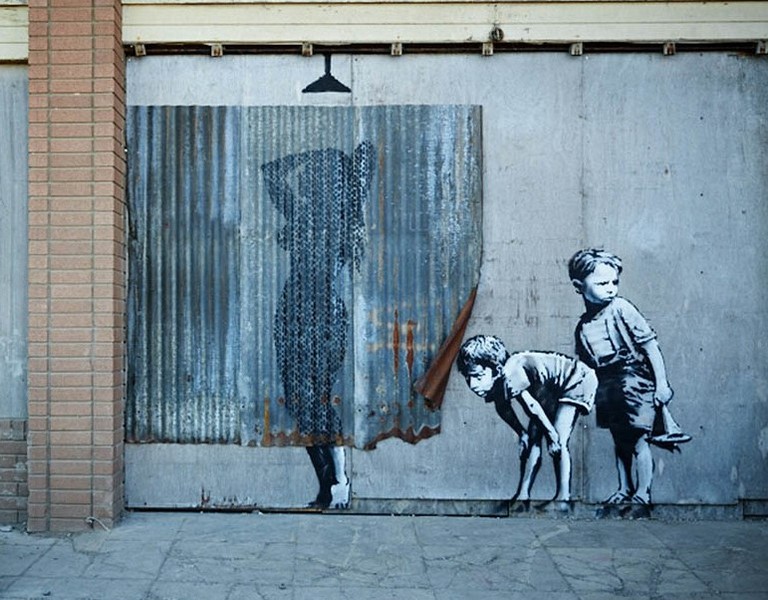
Photo: banksy.co.uk
As is often the case with street art, many of Banksy’s murals were vandalized or removed shortly after appearing. Some, however, have been preserved behind protective Plexiglas panels to prevent theft or damage. Banksy documented many of these works in his 2005 book Banksy: Wall and Piece, as well as through his active Instagram account, where he continues to announce and document his artistic activities.
Today, describing Banksy merely as a street artist is no longer sufficient. His work has been exhibited in prestigious museums and sold at auction for millions of dollars. In an era dominated by social media and constant exposure, it is exceptionally rare for someone to become such a successful and globally recognized icon while remaining anonymous for so many years.
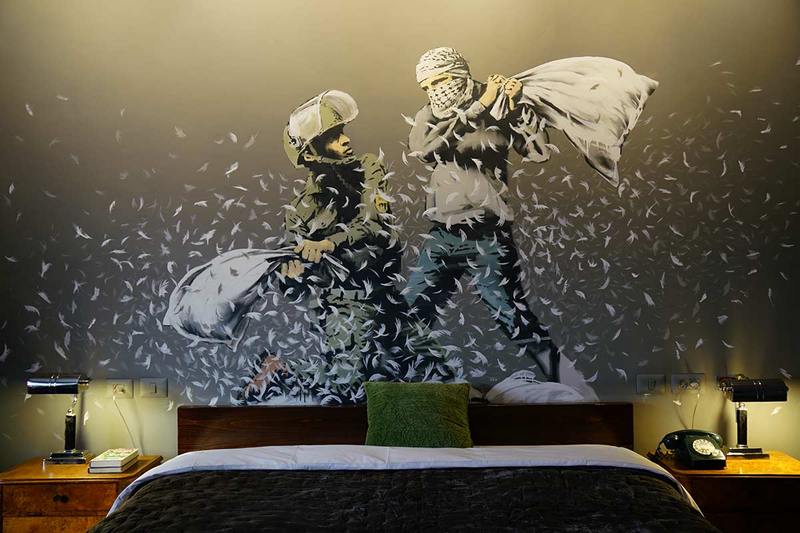
Photo: banksy.co.uk
Master of Provocation
Beginning in the early 2000s, Banksy achieved international fame, thanks in part to a series of creative stunts that generated widespread media attention and transformed him into a celebrated and daring cultural figure.
Throughout the years, he challenged the art establishment by secretly hanging his own works in major museums without the knowledge of staff. These institutions included Tate Britain, the British Museum, the Brooklyn Museum, the American Museum of Natural History, the Metropolitan Museum of Art, and MoMA in New York. He later posted the works on his website and offered prizes to anyone who could locate and photograph them, sparking considerable public discussion.
In 2004, Banksy orchestrated one of his most famous pranks, causing confusion throughout the British economy. He produced counterfeit £10 notes featuring Princess Diana in place of Queen Elizabeth II and the words “Banksy of England” instead of “Bank of England.” The notes were anonymously scattered over a crowd in London’s Notting Hill district, leading some people to attempt using them in local shops. Today, these notes are sold on eBay for around £200 each. One signed note fetched £24,000 at a British auction in 2007.
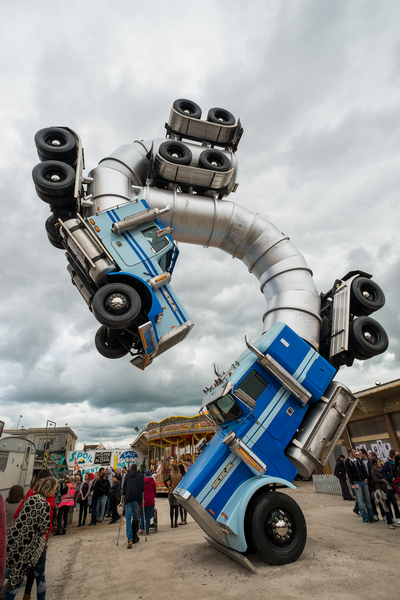
Photo: Shutterstock
In 2013, as a critique of art consumers and the commercialization of art, Banksy set up a modest stall in New York’s Central Park and sold original prints for just $60 each. Passersby assumed the works were counterfeit, and only a handful of people made purchases. The following day, Banksy revealed the project online. The fortunate buyers discovered that the value of their acquisitions had skyrocketed, with some later selling for between £50,000 and £70,000.
During the same year, Banksy captivated New Yorkers by unveiling a new artwork somewhere in the city almost every day. Through Instagram, he provided clues to each location, effectively turning the city into a giant treasure hunt. The phenomenon became so intense that some enthusiasts went as far as breaking apart painted walls in an attempt to sell them.
In 2015, Banksy launched one of his most ambitious projects in a seaside town in western England: Dismaland, a dark parody of Disneyland. The large-scale collaborative project featured 58 artists from around the world, including Israeli artists Ronit Baranga and Neta Harari Navon.
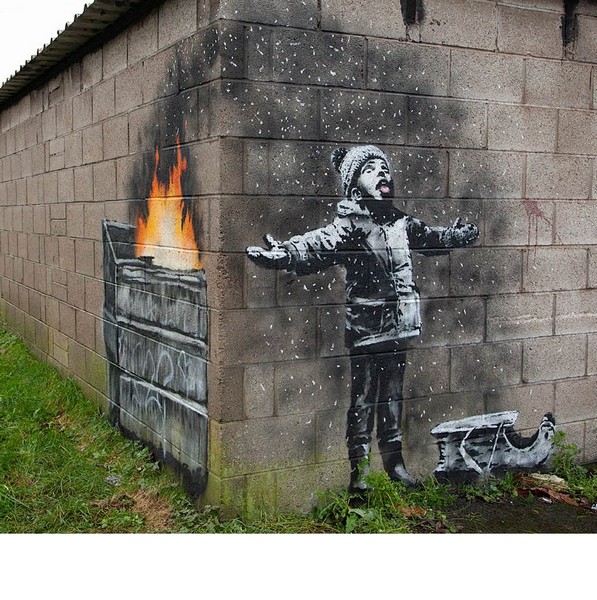
Photo: banksy.co.uk
A Hotel Beside the Wall
As part of his political agenda, Banksy traveled to Bethlehem in 2007, where he and 15 other street artists painted murals on the Israeli West Bank barrier, expressing opposition to the Israeli presence in the territories.
Nine years later, he opened a small hotel adjacent to the barrier called the Walled Off Hotel—a humorous play on the luxury Waldorf hotel brand. Banksy famously described it as “the hotel with the worst view in the world,” referring to its direct view of the separation barrier. The hotel’s lobby and rooms are adorned with numerous Banksy artworks, creating a unique and immersive experience. One room features a large mural depicting a masked Palestinian and an Israeli soldier engaged in a pillow fight.
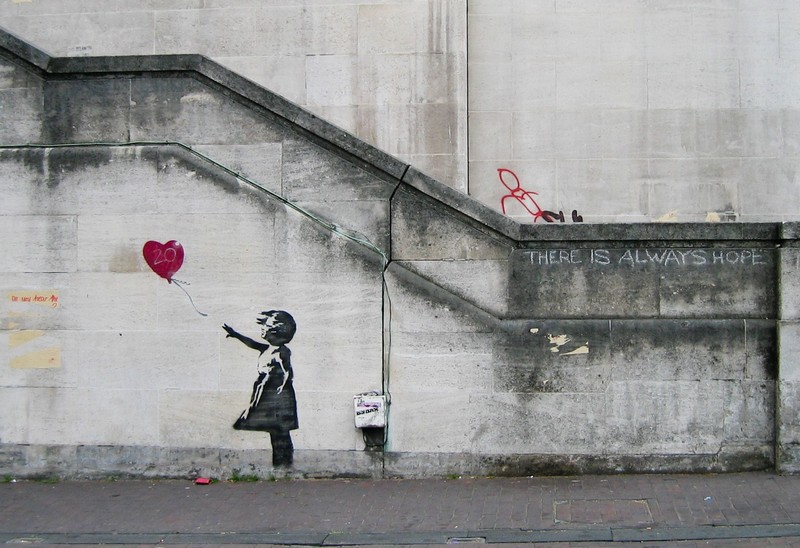
Photo: Wikimedia Commons
The Artwork That Destroyed Itself
In 2018, Banksy staged a dramatic protest against the elitism of the art market and the capitalist culture surrounding the sale of artworks for astronomical sums. He stunned the audience at Sotheby’s in London when his famous work Girl with Balloon partially destroyed itself moments after being sold for $1.4 million.
Banksy later released a video showing how he had secretly installed a paper shredder inside the frame, operated remotely. Immediately after the sale, an accomplice activated the mechanism, and the artwork began passing through the shredder before the astonished crowd. Ironically, the partially shredded piece became even more valuable afterward, and the art world was left in shock at the audacity of an artist who continues to surprise and challenge expectations.