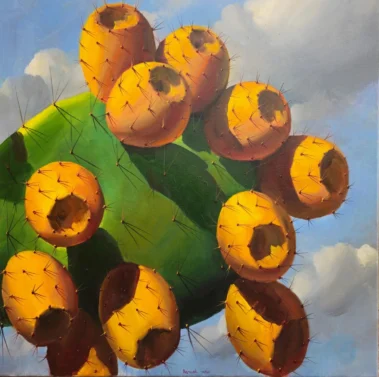
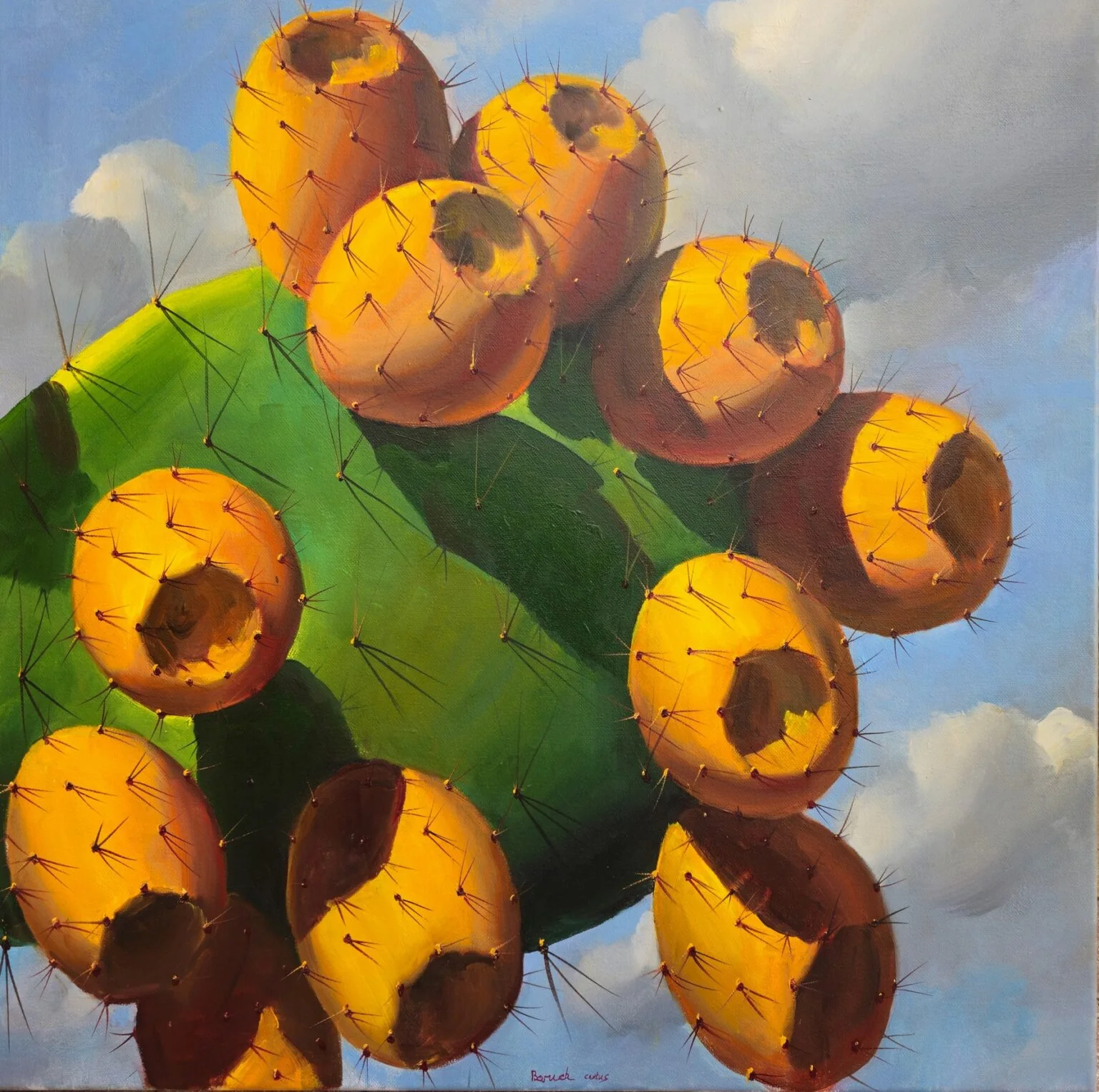
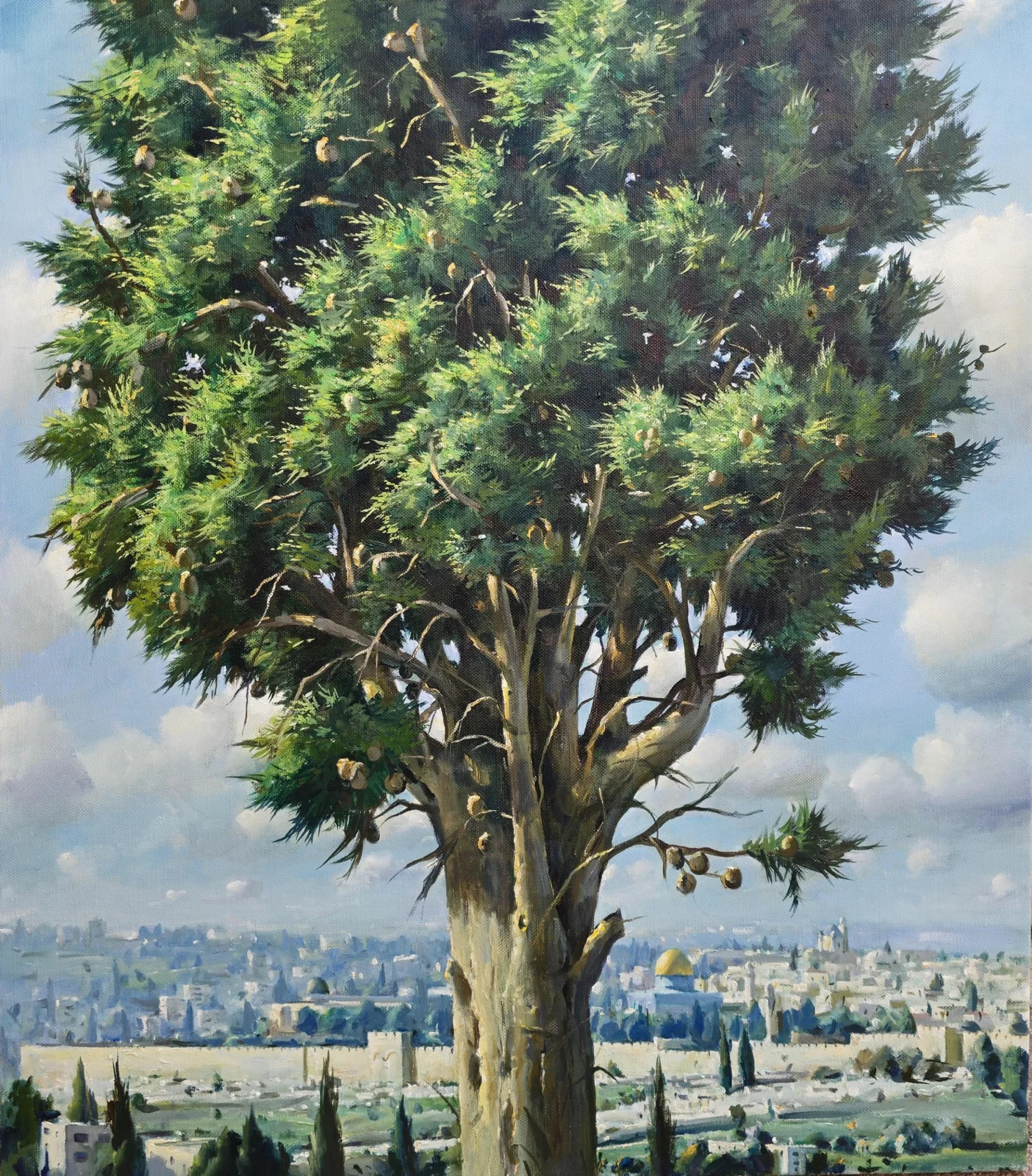
Ilan Baruch is well known and respected on the local art scene for his landscapes, still lifes and portraits. Born in 1974, he grew up in an ultra-Orthodox religious family in Jerusalem’s Geula neighbourhood. As a teenager, he decided to leave the ultra-Orthodox way of life and devote himself to art. He paints realistically in oils on canvas or wood. His subjects are the landscapes of his childhood and his life: Jerusalem, Judea and Samaria, outposts, prickly pear bushes and cypress trees, Arab figures, shepherds in grazing fields, settlers and people returning to religious observance. He records them all as part of the local culture and landscape of the land of Israel.
Baruch paints outdoors. His studio is in Kfar Ruth, near Modiin, and he sets out from there to paint in nature through direct observation of his subject, capturing changes in movement, shadow and light.
The prickly pear and cactus, among the symbols of the land of Israel, recur throughout Baruch’s work—sometimes cultivated and sensual, sometimes thorny, prickly and threatening—as a metaphorical link between the place and its inhabitants. His paintings appear tranquil and pastoral, yet contain elements of tension, such as smoke in the background, a separation fence or a watchtower, hinting at Israel’s complex reality.
Baruch’s works are held in the collections of the Israel Museum, the Tel Aviv Museum of Art, the Ashdod Art Museum and the Janco-Dada Museum in Ein Hod, as well as important private collections. He has held solo exhibitions at the Helena Rubinstein Pavilion of the Tel Aviv Museum of Art, the Ashdod Art Museum, the Ramat Gan Museum of Art and the Artists’ House in Jerusalem.