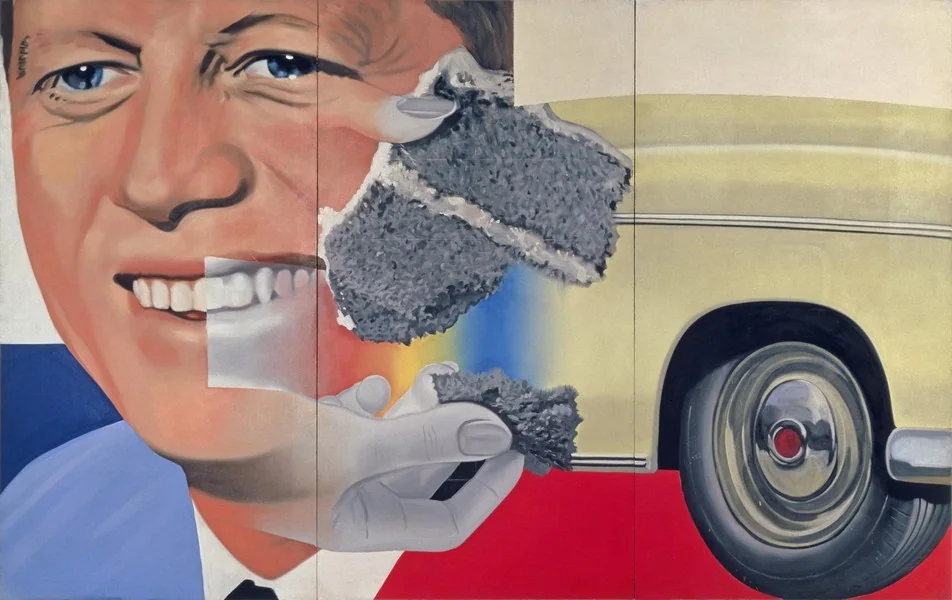
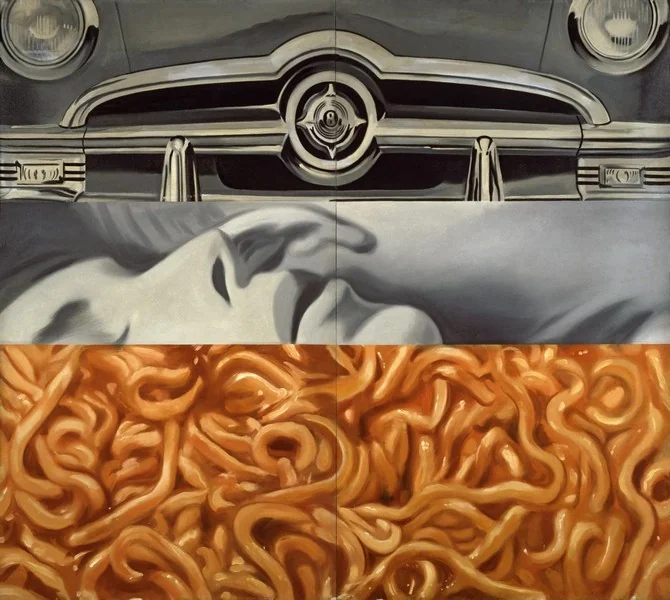
American Pop artist James Rosenquist (1933–2017) became known for his large-scale collage paintings and prints, composed of commercial imagery from advertising and popular culture. As a young man, he worked as a commercial billboard painter, an experience that influenced the content and distinctive style of his art. His works feature a palette of vivid, bold colours and a collage style in which discontinuous fragments of images are layered over one another, creating a kind of puzzle for the viewer.
In the 1960s, Rosenquist’s works appeared in all the groundbreaking exhibitions that established Pop art as a movement. In 1964–65, he presented a much-publicised exhibition against the Vietnam War at the Leo Castelli Gallery in New York. He created a vast collage of 59 panels incorporating images of the American F-111 bomber, over which he placed fragments of colourful advertisements: cakes, tyres, light bulbs, a fork stuck into spaghetti, a girl beneath a hairdryer and more.
Works by Rosenquist are held in the collections of the Art Institute of Chicago, the Museum of Modern Art in New York, the National Gallery of Art in Washington and Tate in London.