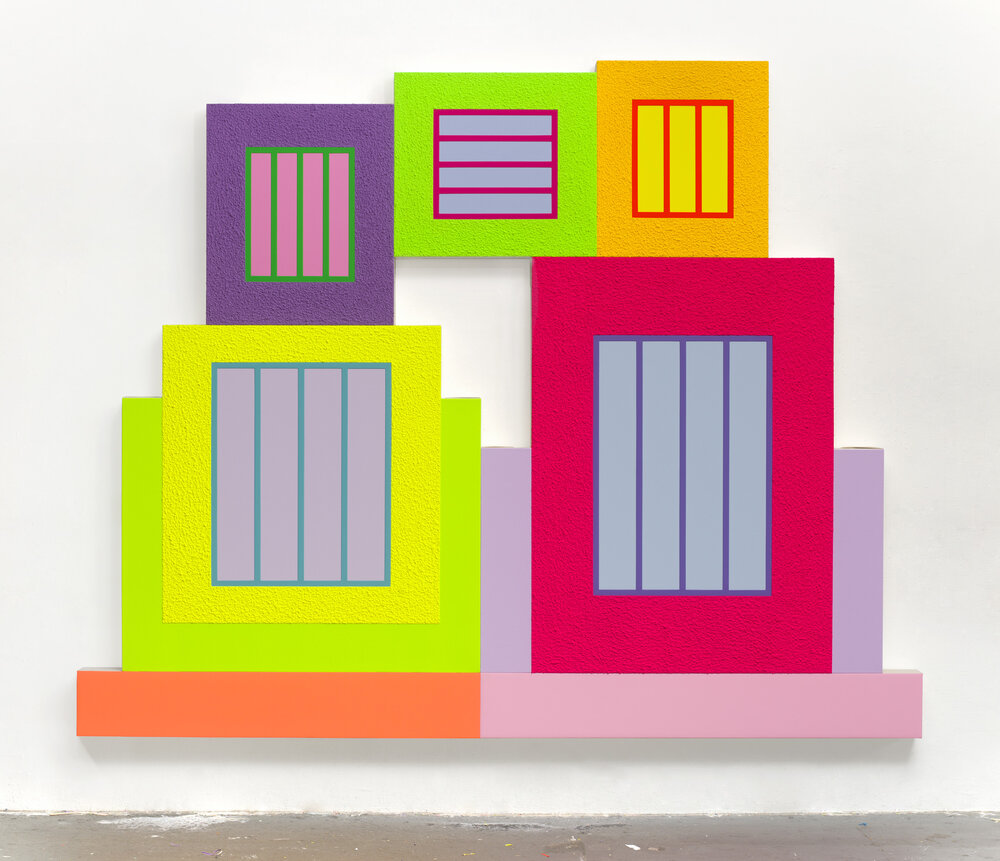
Peter Halley is an American artist and a leading figure of the Neo-Conceptual movement of the 1980s. He is best known for his minimalist geometric paintings rendered in vivid fluorescent neon colors.
New York City has had a lasting influence on Halley’s artistic language. He became fascinated by the city’s geometric grid plan, where streets intersect at right angles to form an orderly network. Halley also expressed his sense of urban isolation through architectural motifs resembling barred rectangular windows, which he referred to as “prisons” and “cells.” These forms are connected by straight, angular lines resembling pipes or the schematic diagrams of urban infrastructure. Developed in the early 1980s, these motifs became the foundation of his artistic practice for decades to come.
Halley employs fluorescent neon pigments to heighten the intensity of color, creating luminous surfaces that recall the artificial glow of postmodern life and the bright commercial signs characteristic of the 1980s.
He drew inspiration from the geometric language of artists such as Dutch painter Piet Mondrian, German artist Josef Albers, and American minimalist Donald Judd. Alongside his artistic career, Halley served for nine years as Director of Graduate Studies in Painting and Printmaking at the Yale University School of Art. He also founded and published Index, a magazine featuring interviews with influential figures from the worlds of fashion, music, film, and contemporary art.
Halley’s works regularly achieve six-figure prices at auction, and many are held in the permanent collections of major institutions, including the Art Institute of Chicago, The Museum of Modern Art (MoMA), the Whitney Museum of American Art in New York, Tate in London, the Centre Pompidou in Paris, and the Museum of Contemporary Art (MOCA) in Los Angeles.
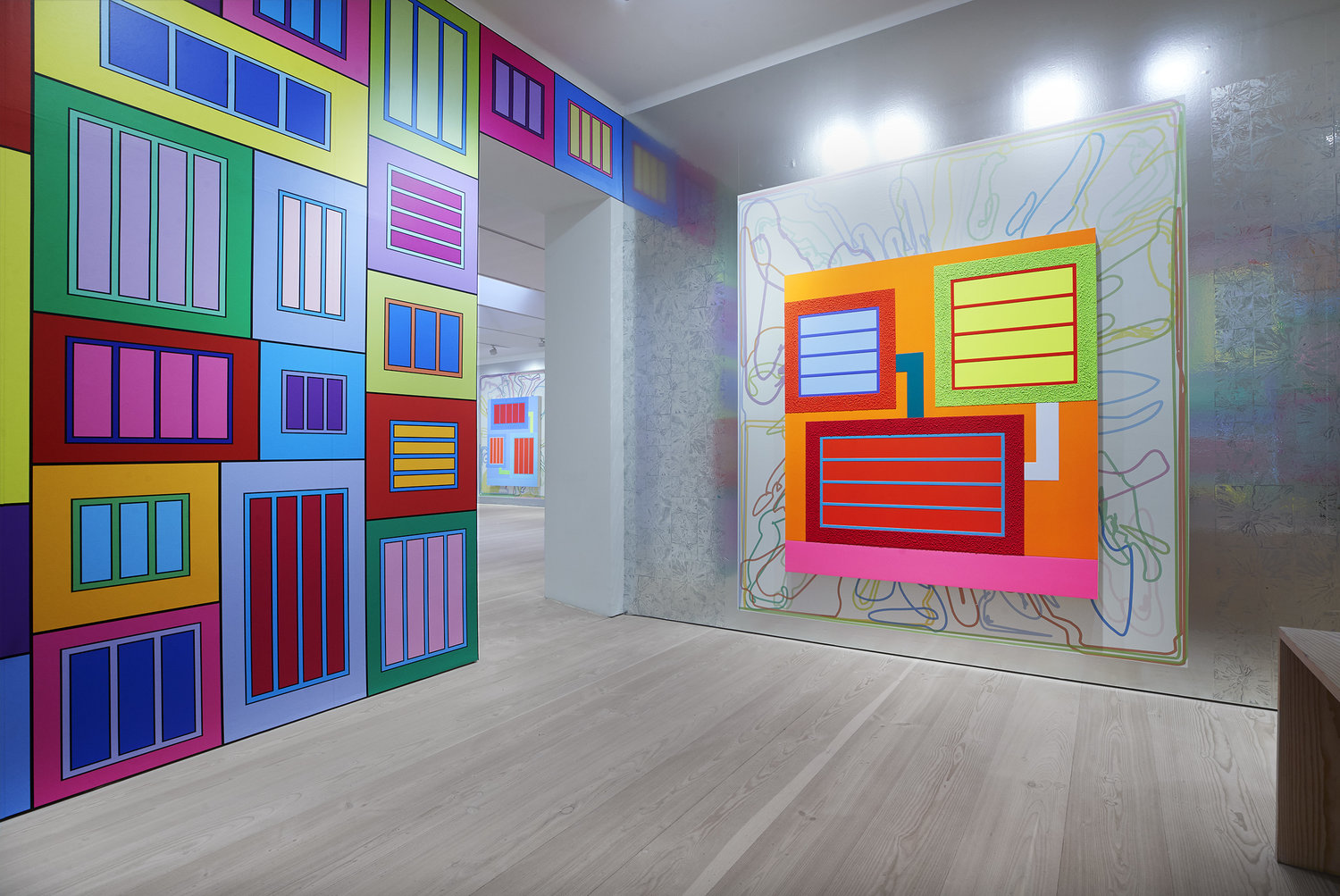
A vibrant exhibition of Peter Halley’s work at Galerie Forsblom in Stockholm.
Bottom Line: Bold color, right angles, and the architecture of modern isolation.